 Maritime Monster All Jobs Moored Here
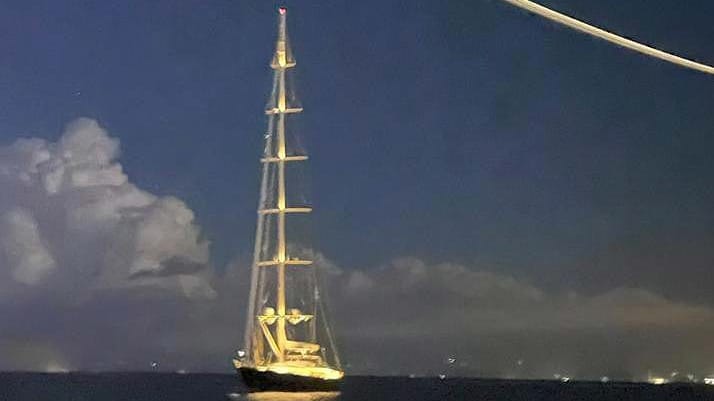
The UK Marine Accident Investigation Branch has completed its final report on the knockdown and sinking of the superyacht Bayesian, the luxury sailing yacht belonging to British tech executive Michael Richard Lynch. As expected, MAIB concluded that “with no sails set, Bayesian was vulnerable to knockdown in severe winds” because of the design of her ultra-tall single mast. To get at the physics of Bayesian’s final moments, MAIB commissioned the University of Southampton’s Wolfson Unit for Marine Technology to analyze the casualty. Bayesian had a single aluminum mast that soared about 235 feet above the water, as high as a commercial office building, and the investigators assessed whether its size and surface area could make the vessel more vulnerable to a knockdown in high winds. Based on the characteristics of the mast and the stability condition of the vessel, the Wolfson Unit study found that if the wind was blowing directly onto Bayesian’s beam, a gusting wind speed in excess of 63 knots would likely cause a knockdown and capsizing.
In the early hours of August 19, 2024, Bayesian was anchored off Porticello, Sicily to wait out windy weather. Her centerboard was raised and sails were all furled, all reportedly compliant with the terms of her stability booklet. Winds picked up at 0300 and strengthened to 30 knots by 0355. At 0406, Bayesian capsized to starboard suddenly and violently, then sank. Six passengers and the yacht’s chef died in the casualty, and 15 were rescued at the scene.
The vessel’s master told media after the casualty that “we didn’t see it coming,” and local prosecutors have investigated his actions with a view to possible manslaughter charges. But unlike the prosecutors (and the Bayesian’s builders), MAIB did not point to crewmember error as a critical factor in the casualty – finding instead that design, stability analysis and documentation played key roles. But the risks of operating in the vessel’s bare-mast, keel-up configuration in high winds “were not identified in the stability information book carried on board,” MAIB found. This meant that the crew were not aware of the danger they faced in a rapidly-strengthening downburst; as they expected to remain upright while at anchor, they did not scramble to secure external doors, flush hatches and hull openings at the onset of gusty wind conditions, MAIB noted. “It is unlikely that downflooding into Bayesian’s internal spaces had a material effect on its foundering until the yacht was lying on its side, by which time it was unable to right itself,” MAIB concluded.
FULL ARTICLE AVAILABLE HERE: maritime-executive.com