Maritime Monster All Jobs Moored Here
https://maritime.monster/wp-content/uploads/2026/04/russian-amphib-hit-gur-prymary-april-2026-765e91-1.jpg
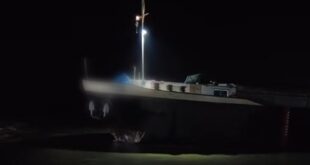
Overnight Saturday, in a reprise of an earlier era in the Russia-Ukraine conflict, a drone strike team from Ukraine’s military intelligence directorate hit two moored landing ships at the Port of Sevastopol, about 150 nautical miles from Ukrainian-controlled territory. While the operation would have been remarkable three years ago, this time the strike was overshadowed by Ukraine’s increasingly successful attacks on Russian petroleum infrastructure. The attack was noteworthy for its location: the Russian Navy previously pulled most of its assets out of Sevastopol because of severe Ukrainian drone and missile threats. Despite the known risk, two attractive targets – landing ships Yamal (a Project 775 Ropucha-class) and Nikolay Filchenkov (a Project 1171 Tapir-class) – were in port on Saturday. These ships are designed for amphibious assault, but Russia has primarily used its Black Sea amphibs for ferrying military supplies around the theater, from mainland Russia to the Kerch Strait to the Sea of Azov. This shipping service may be in higher demand, as Ukraine recently disabled the rail ferry service at Kerch Strait, which was a primary connector for Russian military shipments heading into Crimea. The special-mission unit “Prymary,” a Crimea-focused task force within the defensed intelligence agency GUR, conducted strikes targeting the topsides of both the Yamal and the Filchenkov. As part of the mission, its operatives also destroyed a $5 million Podlyot-K1 radar system – a common tactic in the conflict, intended to blind air defenses to incoming drones. The extent of the damage from the strike is still being assessed, Ukraine’s General Staff said Monday. Stay on Top of the Daily Maritime News The maritime news that matters most Get the latest maritime news delivered to your inbox daily. Subscribe Now // Global validation function (only defined once) if (!window.validateEmailSignupForm) { window.validateEmailSignupForm = function(form) { const input = form.querySelector(‘.email-signup__input’); const email = input.value.trim(); input.classList.remove(‘error’); if (!email || !email.includes(‘@’) || !email.includes(‘.’)) { input.classList.add(‘error’); input.focus(); return false; } return true; }; } // Fetch fresh CSRF token for all forms (only once) if (!window.csrfTokenFetched) { window.csrfTokenFetched = true; fetch(‘/csrf-token’) .then(r => r.json()) .then(data => { document.querySelectorAll(‘.email-signup input[name=”_token”]’).forEach(input => { input.value = data.token; }); }) .catch(() => {}); } // Unique callback for this form instance window.submitEmailSignup_email_signup_69e72dcb0f625 = function(token) { const form = document.getElementById(’email-signup-69e72dcb0f625′); if (window.validateEmailSignupForm(form)) { form.submit(); } }; The Prymary group has been active since at least 2025, and has previously released footage showing hits on Russian Mig-29 fighters on the ground in Crimea, along with small landing craft, air defense systems, radars and other targets. Last week, Ukrainian forces also hit the oil terminal at Tuapse, twice – once on Thursday and again on Sunday. Russian forces confirmed the strikes and said that one person had been killed. The attacks were the latest in an increasingly dramatic series of long-distance strikes on Russian oil export infrastructure, from Novorossiysk to Ust-Luga to Primorsk.
Original article available on the page of publisher.
ARTICLE LINK: maritime-executive.com